
Last checked: October 2026, against the French order of 5 January 2021.
Taking a lorry, coach, bus or motorhome over 3.5 tonnes into France? You'll need angles morts blind spot stickers before you drive on French roads, and that includes UK-registered vehicles.
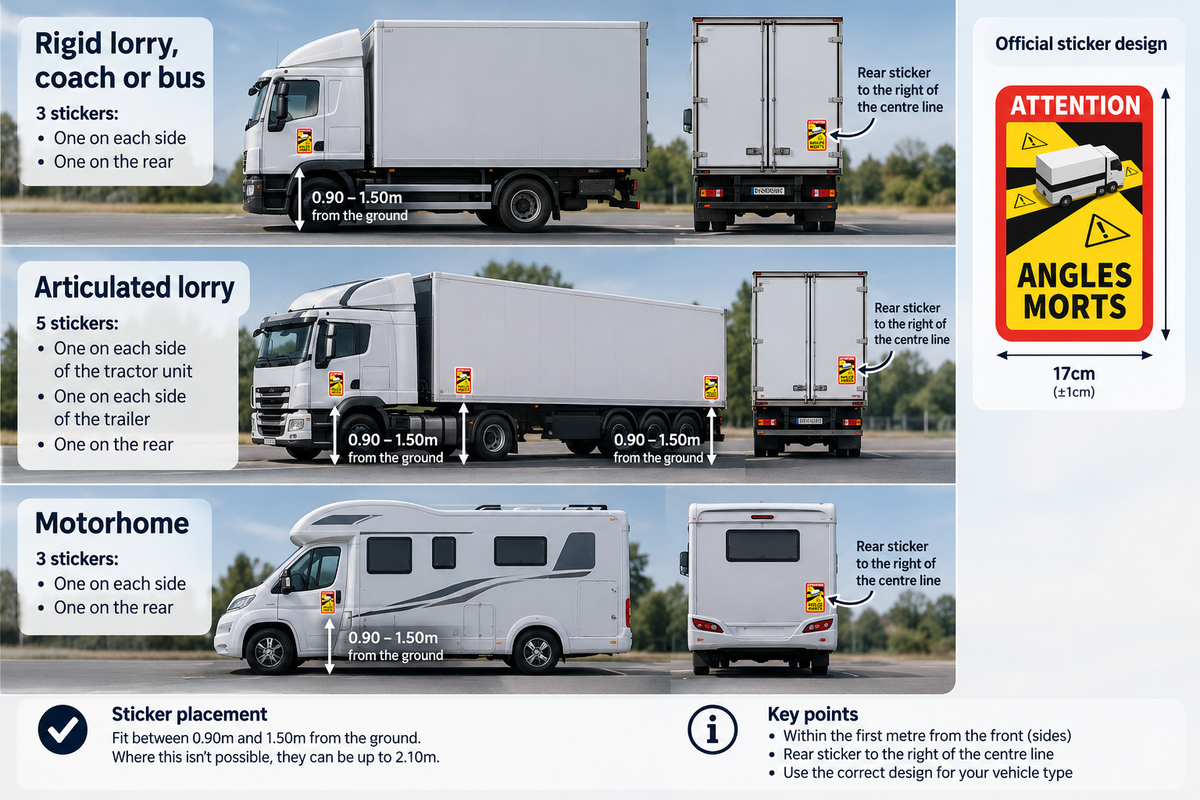
For a typical rigid vehicle or motorhome, that means three stickers: one on each side and one on the rear. An articulated lorry needs five across the tractor unit and trailer, and we'd recommend six.
This guide explains which vehicles need them, exactly where they go and what the fines are if you get it wrong.
The 30-second answer
| Vehicle (over 3.5 tonnes) | Stickers needed |
|---|---|
| HGV / rigid lorry | 3 |
| Coach / bus | 3 |
| Motorhome | 3 |
| Tractor unit + semi-trailer | 5 (6 recommended) |
| Articulated bus | 5 |
Stickers must be the official French design, 25cm × 17cm, and fitted 0.90m–1.50m from the ground. The standard fine is €135.
Travelling to France soon? Shop regulation-size angles morts stickers →
Where angles morts stickers go
The rule is the same for every vehicle. There's one sticker on each side within the first metre from the front, and one on the rear to the right of the centre line. All of them go between 0.90m and 1.50m from the ground.


Which vehicles need angles morts stickers?
Any vehicle with a gross vehicle weight over 3.5 tonnes that carries goods or passengers on French roads. In French paperwork, gross vehicle weight is called the PTAC. That covers:
- HGVs and lorries, rigid or articulated
- Trailers and semi-trailers
- Coaches and buses
- Motorhomes over 3.5 tonnes
- Heavy vans and horseboxes over 3.5 tonnes
It applies whether you're delivering in France or just driving through it to Spain, Italy or Switzerland. If the wheels touch French roads, the stickers need to be on.
Vehicles fitted with blind spot markings under the rules of another EU country are accepted. The UK isn't in the EU, though, so UK vehicles should carry the French design.
Exempt: agricultural and forestry vehicles, winter maintenance vehicles, and motorway and dual-carriageway maintenance vehicles. A vehicle can also be exempt from side or rear markings where its structure makes fitting them impossible.
Motorhomes: check your weight first
This is where most UK private drivers get caught. Look at the gross vehicle weight on the plate (usually in the door shut or under the bonnet) or on your V5C.
- 3,500kg or under: you don't need them. The rule only applies over 3.5 tonnes.
- Over 3,500kg: you need three. That includes vans that have been re-plated or upgraded to a higher weight.
On most motorhomes, the side stickers go on the lower part of the cab door, below the window. The rear one goes below the rear window, to the right of centre.
Exact positioning rules
| Vehicle | Sides | Rear |
|---|---|---|
| Rigid lorry, coach, bus, motorhome | Within the first metre from the front, not on glass | Right of the centre line |
| Tractor unit | Within the first metre from the front, not on glass | Wherever the design allows, such as the back of the cab or chassis |
| Semi-trailer | Within the first metre behind the kingpin | Right of the centre line |
| Drawbar trailer | Within the first metre of the front bodywork | Right of the centre line |
| Articulated bus | Within the first metre of each section, not on glass | Right of the centre line |
- Height: 0.90m–1.50m from the ground. If the vehicle's design makes that impossible, fit them as close as possible, up to a maximum of 2.10m.
- "Right of centre" means the right-hand side as you stand behind the vehicle, which is the kerb side in France.
- Not on windows. Side stickers must not go on glass.
- Coaches and buses with glass doors or large front windows can fit the side stickers as close to the front as possible, up to 3m back.
- Don't cover anything else. Stickers mustn't obscure number plates, lights, other required markings or the driver's view.
- Awkward bodies: tankers, car transporters, container carriers, flatbeds and skip loaders can put the rear sticker wherever their design allows.
Why we recommend six stickers for an artic
The French order expects tractor units to carry a rear marking too. It specifically allows them to fit it wherever their design permits. When coupled, that sticker is hidden behind the trailer, but if the unit runs solo in France it needs one. A sticker on the back of the cab or chassis covers you either way. Two on the unit sides, one on the unit rear and three on the trailer makes six, which is exactly one pack.
Size and design
- Size: 25cm high × 17cm wide, with a tolerance of ±1cm either way.
- Design: the model set out in the French order is mandatory, including its colours. There's a lorry version and a bus/coach version.
- Fixing: the order allows stickers to be glued, riveted or fixed "by any other means", or painted or stencilled onto the bodywork.
Smaller angles morts stickers are sold for cars and small vans, but they don't meet the 25 × 17cm requirement. If your vehicle is over 3.5 tonnes, use full-size stickers.
Fines
Not displaying the stickers is a fourth-class offence in France:
- €135 standard fixed penalty
- €90 if paid promptly
- €375 if paid late
- Up to €750 if it goes to court
For a fleet, the bigger cost is usually the delay: a roadside stop, a driver behind schedule, and a delivery that's late, all for a sticker that costs a few pounds.
Fitting advice
A tip from us: if you're fitting a fleet, order a few more than the legal minimum. Stickers get damaged by pressure washing, body repairs and trailer swaps, and a replacement always seems to be needed five minutes before a vehicle is due to leave. For vehicles that go into France regularly, especially where trailers are swapped between units, keep spare sets at the depot.
- Clean and dry the panel first. Vinyl applied over road film or wax won't last.
- Avoid ribs, rivets and panel joins on box bodies. A sticker that lifts at the edge soon goes in the wash.
- Curtainsiders: the side sticker behind the kingpin usually has to go on the chassis rail or a solid front panel, not the curtain. Check there's a flat area in the height zone before you start.
- Add it to the walkaround check for any vehicle going abroad. It takes seconds.
Choosing the right sticker
For most UK operators, the choice comes down to vehicle type and material:
- Lorry / HGV: standard lorry pictogram
- Coach / bus: passenger vehicle pictogram
- Motorhome: angles morts stickers for motorhomes
- Occasional France trips: magnetic versions can be more convenient, as long as the bodywork is steel. Magnets won't stick to aluminium, GRP or curtains, and they need checking before every journey.
All of our full-size versions are 250 × 170mm and come in packs of six.
Other markings worth checking before European travel
None of these are part of the angles morts rule, but they're worth checking while the vehicle's in the yard:
- UK identifier: since September 2021, UK vehicles driving abroad need a UK identifier, either on the number plate or as a separate UK sticker. Old GB stickers are no longer valid.
- Vehicle height: a clear max vehicle height sticker in the cab matters more when you're dealing with unfamiliar bridges and height signs in metres.
- Cyclist warning signs: if the same vehicles work in London, Direct Vision Standard permits have their own cyclist warning signage requirements.
Our truck, trailer and HGV signage guide covers the rest. For fleet orders, get in touch.
Frequently asked questions
Do UK lorries need angles morts stickers in France?
Yes. Any vehicle over 3.5 tonnes on French roads needs them, wherever it's registered.
Do I need angles morts stickers when driving through France to Spain?
Yes. The rule applies to any driving on French roads, including transit.
Does a 3.5 tonne motorhome need angles morts stickers?
No. The rule applies over 3.5 tonnes, so a motorhome plated at exactly 3,500kg doesn't need them. One plated at 3,850kg does.
Where do angles morts stickers go on a motorhome?
One on each side, usually on the lower cab door within the first metre from the front, and one on the rear, to the right of centre. All of them go 0.90m–1.50m from the ground.
How many angles morts stickers does an articulated lorry need?
Five: two on the tractor unit and three on the semi-trailer. We recommend a sixth on the back of the unit so it's covered when running solo.
Can angles morts stickers go on windows?
No. Side stickers must not be fitted on glass.
Are magnetic angles morts signs legal in France?
The French order allows markings to be fixed "by any other means" as well as glued or riveted, and it doesn't rule out magnets. They must still be the correct size and design, in the right position, and on the vehicle whenever it's in France.
What size are angles morts stickers?
25cm high × 17cm wide, ±1cm.
What's the fine for not having angles morts stickers?
€135, reduced to €90 if paid promptly, and up to €750 if it goes to court.
Sources
This guide is based on the French order of 5 January 2021 on blind spot markings for heavy vehicles (Arrêté du 5 janvier 2021, Légifrance) and decree no. 2020-1396 of 17 November 2020, which added article R. 313-32-1 to the French Code de la route. We've summarised it in good faith, but it isn't legal advice. Regulations can change, so check the current position before you travel.